Asier Mendizabal
The Orb According to the J. L. Collection
- Bilbao Museoa, Bilbao (ES)
- 06.10.2026–24.01.2027
The Colección Patricia Phelps de Cisneros comprises a remarkable group of works that together form the visual narrative of a key chapter in the history of the Americas: the intellectual curiosity and fascination that artists and travellers from Europe and the Americas felt in response to the exuberance of Latin American landscapes.
In fact, until the emergence of the so-called local schools in Latin America in the late nineteenth century, it was these traveller artists who, through their works, shaped images of the Americas that would spark the imagination of those undertaking the expeditions in which they participated. They include the Baroque painter Frans Post, who is represented here by two extraordinary landscapes, and the celebrated naturalist and geographer Alexander von Humboldt, whose work is represented by two publications on display that include examples of his Naturgemälde, as well as images and accounts that would prove decisive for future scientists, artists and travellers.
By way of an epilogue, Asier Mendizabal revisits an exhibition originally made for a Pre-Columbian art museum in Ecuador with the addition of a new project. Commissioned by Quito’s Museo Casa del Alabado, and inaugurating its Zarigüeya programme of artistic interventions, in 2016 Mendizabal created Problems of Style and Earthenware Vessels, in which the artist questioned the limitations of the European scientific perspective that, throughout the twentieth century, subjected objects from other cultures to comparative systems that were sometimes of questionable rigour. To do so he formally examined the classification work of Paul Rivet, which was the culmination of his early experience as an anthropologist in Ecuador, as he turned towards ethnography and founded the Musée de l’Homme in Paris.
In 2025, a large part of Mendizabal’s exhibition was acquired by the Bilbao Fine Arts Museum, which presents it now in a re-contextualised and expanded form with a previously unseen project. The new works, which include a publication with essays by the artist, stem from the strange circumstances surrounding the creation of the Inca art collection that the Bilbao-born poet Juan Larrea assembled and donated to the Spanish Republic in the midst of the Spanish Civil War. They also derive from the coincidence—one of the many that have woven this project together—that Paul Rivet was the first to show the collection upon its arrival in Europe.
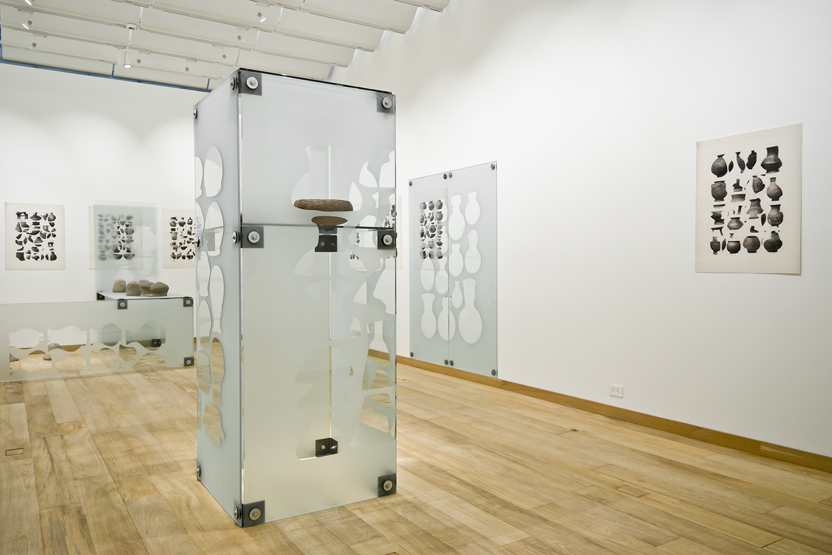
Asier Mendizabal, Problems of Style and Clay Vessels, Bilbao Fine Arts Museum, 2016
mixed media