Svenja Deininger
On Leaning
- Federica Schiavo Gallery, Rome (IT)
- 13.10.–23.01.2026
Federica Schiavo Gallery is pleased to present On Leaning, an exhibition of new works by Svenja Deininger.
Svenja Deininger’s paintings are made by refusing the clean beginning. There is no preparatory certainty, no underlying drawing waiting to be faithfully realised. Instead, the works arrive through repeated attempts: forms are placed, altered, partially covered, allowed to persist, then reconsidered. Accumulation becomes a method of looking. What matters is not simply what finally appears, but the pressure exerted by what has been there before.
This history is rarely explicit. It survives as a kind of residue: in a change of density, a colour that seems to have migrated beneath another, an edge whose precision is complicated by what surrounds it. Deininger’s surfaces are neither transparently layered nor insistently material. Raw linen, matte passages and more concentrated areas of paint establish a fluctuating register between exposure and concealment. The paintings seem quiet, but their quietness is active. One is continually made aware that the image has been calibrated rather than simply composed.
This is also why the question of what, exactly, one is looking at remains productively unresolved. A curve can suggest the contour of a body; a vertical can read as an architectural element; a horizontal plane might recall a fragment of landscape. Yet these possibilities do not settle into representation. Deininger’s paintings occupy the unstable territory where abstraction begins to acquire the habits of figuration without becoming figurative. Recognition is offered and withdrawn. The eye proposes an object, only to find itself returned to the surface.
At the entrance to the exhibition, this problem of looking becomes physical. A canvas is installed perpendicular to the wall, so that from a frontal approach it is reduced almost to a line. The painting consequently cannot be encountered from a single, privileged position. One moves around it, beneath it; its status shifts between image and object. What is normally treated as a neutral support—the wall, the position of the viewer, the assumed frontality of painting—becomes part of the work’s perceptual situation. Looking is no longer simply directed at an image. It is something the body has to perform.
Scale introduces another form of resistance. A monumental painting, composed from subtle hues and immense detail, exceeds the possibility of immediate comprehension. Its size does not merely enlarge an image; it changes the temporal conditions under which that image can be seen. What might, at a smaller scale, register as a fragment becomes an environment of minute decisions. Texture, depth and internal rhythm emerge gradually, so that duration becomes almost another material of the painting. The longer one looks, the less adequate the first impression becomes.
The works communicate with one another in similarly indirect ways. A line reappears with a different emphasis; a form seems to shift register; a colour or interval finds an unexpected counterpart elsewhere. Such correspondences do not amount to a system, and the exhibition does not resolve itself into a single visual grammar. Instead, its rhythm is produced through recurrence and displacement. Each painting remains distinctly itself, while becoming newly legible in relation to the others.
The title On Leaning proposes a comparable condition. To lean on something is to enter into a relation of support, pressure or dependence. But here the phrase is left incomplete. There is no specified object on which to lean. The action remains suspended, and with it the question of what supports what.
That incompletion is less a metaphor for the paintings than a description of how they operate. Deininger’s forms lean against one another without becoming fixed; layers remain present without becoming fully recoverable; images hover between recognition and abstraction. Even the viewer’s position is unstable, moving between distance and proximity, between seeing the painting as an image and encountering it as a thing in space.
What results is not ambiguity for its own sake. The paintings are resolved, but resolution does not mean closure. Their surfaces contain decisions without explaining them, memories without identifying their sources. They ask for a kind of attention that is neither forensic nor instantaneous: a looking that allows things to remain partially withheld. Meaning, in these works, is therefore less a destination than a shifting relation—between surface and depth, image and object, memory and perception, what can be seen and what continues to lean just beyond it.
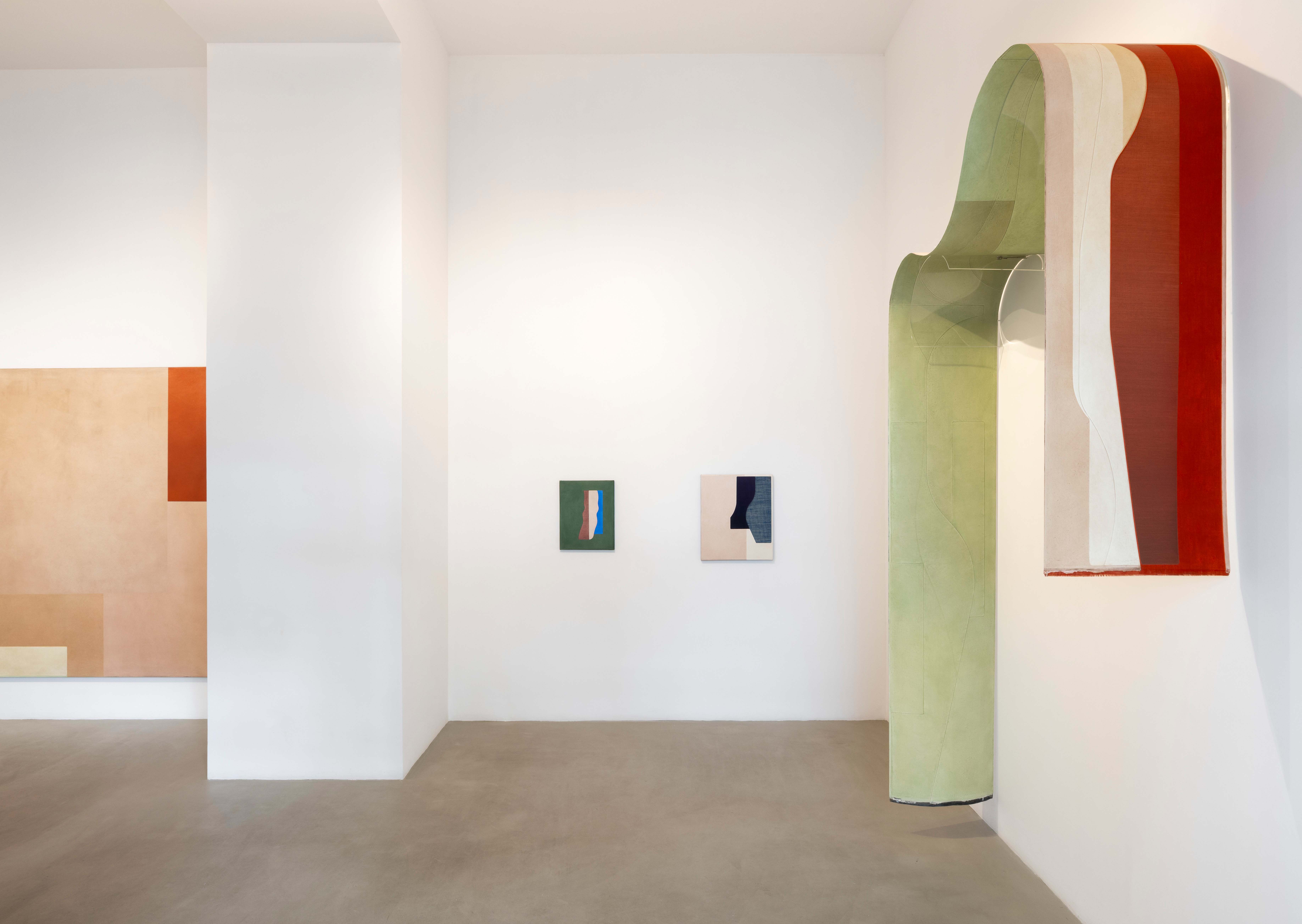
Svenja Deininger, On Leaning, Installation view of the exhibition at Federica Schiavo Gallery, Rome, 2026
Photo: Andrea Rossetti, Courtesy of the artist and Federica Schiavo Gallery