Hugo Canoilas
Dissident Bodies
- D21 Kunstraum. Leipzig (DE)
- 22.04.–19.07.2026
Dissident Bodies brings together works that engage with the body and its experience in an increasingly posthuman present. The exhibition moves away from an anthropocentric understanding that positions the human as the central reference point, instead turning toward subjectivities emerging from technological, ecological, political, and affective entanglements. The body appears as an open assemblage of relations, understood not as a bounded entity but as a permeable structure in a constant state of transformation.
In this context, hybridization, metamorphosis, and fluidity emerge as processes in which corporeal forms overlap, merge, and continuously transform. The tension between nature and technology becomes visible where organic and artificial elements intertwine, dissolving clear distinctions. Embodiment is thus understood as a dynamic process in which body, perception, and identity are continually reconstituted.
By emphasizing the potential of the “in-between,” the exhibition frames queerness, alienation, racialization, and hybridity not as fixed categories but as shifting, relational conditions. The body appears as a movable threshold between identity and alterity, self and other—embedded in a complex web of constantly evolving relations.
Several artistic positions explore these transformations through hybrid or transitional forms. André Romão’s sculptures transport viewers to surreal, melancholic landscapes inhabited by interwoven human, animal, and vegetal presences. Evoking similarly mythic atmospheres, Hugo Canoilas’s works function as porous thresholds between subject and environment. In a related way, Lito Katou’s sculpture stages a post-human grotesque in which organic and synthetic, animate and inanimate elements converge.
Other works address embodiment through questions of identity, technology, and relationality. Across mental imagery, corporeal presence, and online personae, Esse McChesney produces textiles that center queer, non-binary, and trans perspectives grounded in critical intimacy and the exploration of identity. Laila Majid and Louis Blue Newby’s film approaches queerness as a speculative and forward-looking mode of relation, while Odete and Diana Policarpo revisit feminist science fiction through a film that intertwines bioethics, palaeontology, and speculative thought to examine how scientific imaginaries shape regimes of truth and structures of power.
The exhibition also reflects on historical processes through which bodies have been classified, displayed, or silenced. Addressing racialized histories of objectification, Kiluanji Kia Henda presents a portrait that reveals violent mechanisms through which Black bodies have been reduced to objects of display and control. Hugo de Almeida Pinho critically interrogates the boundaries between knowledge and epistemic violence. Eliška Konečná extends this inquiry through works that foreground fragility, intimacy, and corporeal trace.
Alice dos Reis’s film is set in Portugal’s Serra da Gardunha and weaves local stories of mysterious lights with personal experiences, geology, and the theme of unwanted pregnancy. Manuel Sékou’s sound-based work employs layered soundscapes and rhythmic structures, treating sound as a space of encounter that evokes hybrid connections between the organic and the synthetic.
The exhibition takes place within the framework of the annual theme ALIEN and engages with the figure of the “stranger” as a central conceptual motif. In this context, the “alien” is understood both as a non-human figure and as a socially constructed category of otherness, which renegotiates questions of belonging, exclusion, and alienation within the context of posthuman conceptions of the body and identity.
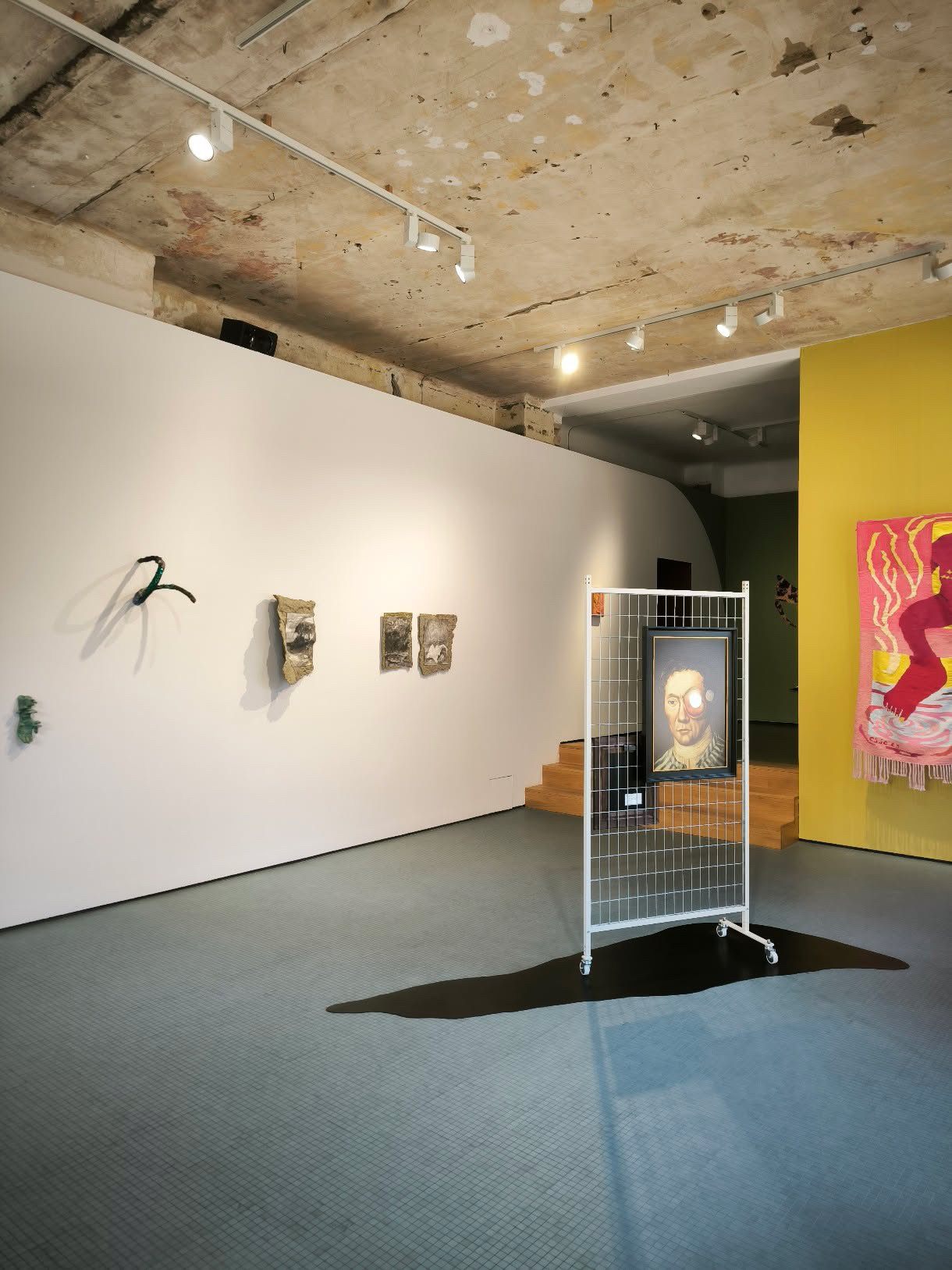
Exhibition view, D21 Kunstraum, 2026