Mladen Stilinović
Bread Stones
- Galleria Civica Trento (IT)
- 16.07.–15.11.2026
We live in a time saturated with post-apocalyptic imaginaries: a present marked by international tensions, wars, and increasingly extreme climate events. Techno-media narratives tend to swing between a reckless, denialist optimism and the vision of an Earth grown inhospitable, exhausted, and beyond repair – a planet to be left behind in favour of new worlds to terraform. Within this framework, the environmental crisis and social fractures are not treated as grounds for radical engagement but as the premise for escape – displacing the possibility of life elsewhere and indefinitely deferring human responsibility towards the planet.
The exhibition enters into critical dialogue with this posture: questioning its impulses of rejection, resisting its escapist tendencies, and proposing an ecology of permanence. Following a line of inquiry developed by the Mart in the Galleria Civica di Trento in recent years, the project renews the museum’s focus on highland territories – mountain zones and elevated areas often marked by harsh environments, extractive processes, and depopulation. This orientation is grounded in the thought of anthropologist Vito Teti. Far from denoting a condition of immobility, his notion of “restanza” is reread here as an ethical choice to inhabit places marked by historical fractures or marginality, echoing Donna Haraway’s call to “stay with the trouble” – understood as a refusal of any escape towards consolatory solutions. Restanza is adopted here as an operative mode that shapes the relationship between artistic practices and territories, through incomplete archives and layered memories. Remains are not inert waste but nourishing matter, preserving the warmth of the life that once inhabited them. Restanza implies a form of attention that resists the contemporary tendency to aestheticise ruin, reasserting the right of places to once again draw our attention. This form of attention is extended to visitors across the museum’s spaces and the urban fabric of Trento, through works from the Mart collection woven together with sitespecific installations by national and international artists. The exhibition unfolds as a constellation of “villages” activated through direct experience. These are clusters of
partial memories – architectures where silence and the slippage of time invite a conscious, unhurried traversal. The visit is no longer a passive experience – it becomes a living process, situated and measured by time. The villages are organised around four fields of intensity: latencies, where remains and apparent absences surface; frictions, marked by incomplete archives, conflicts, and unresolved histories; drifts, shaped by migrations and territorial fractures; reactivations, where gestures and performative practices bring traces into contact with the presence of visitors. In this threshold space, the exhibition refuses definitive answers – opening, instead, onto questions. Even what appears inert – a stone, an abandoned place – may hold something organic, something leavening: alive, like bread. What bread does every stone hold within it?
Curated by
Giulia Colletti and Gabriele Lorenzoni
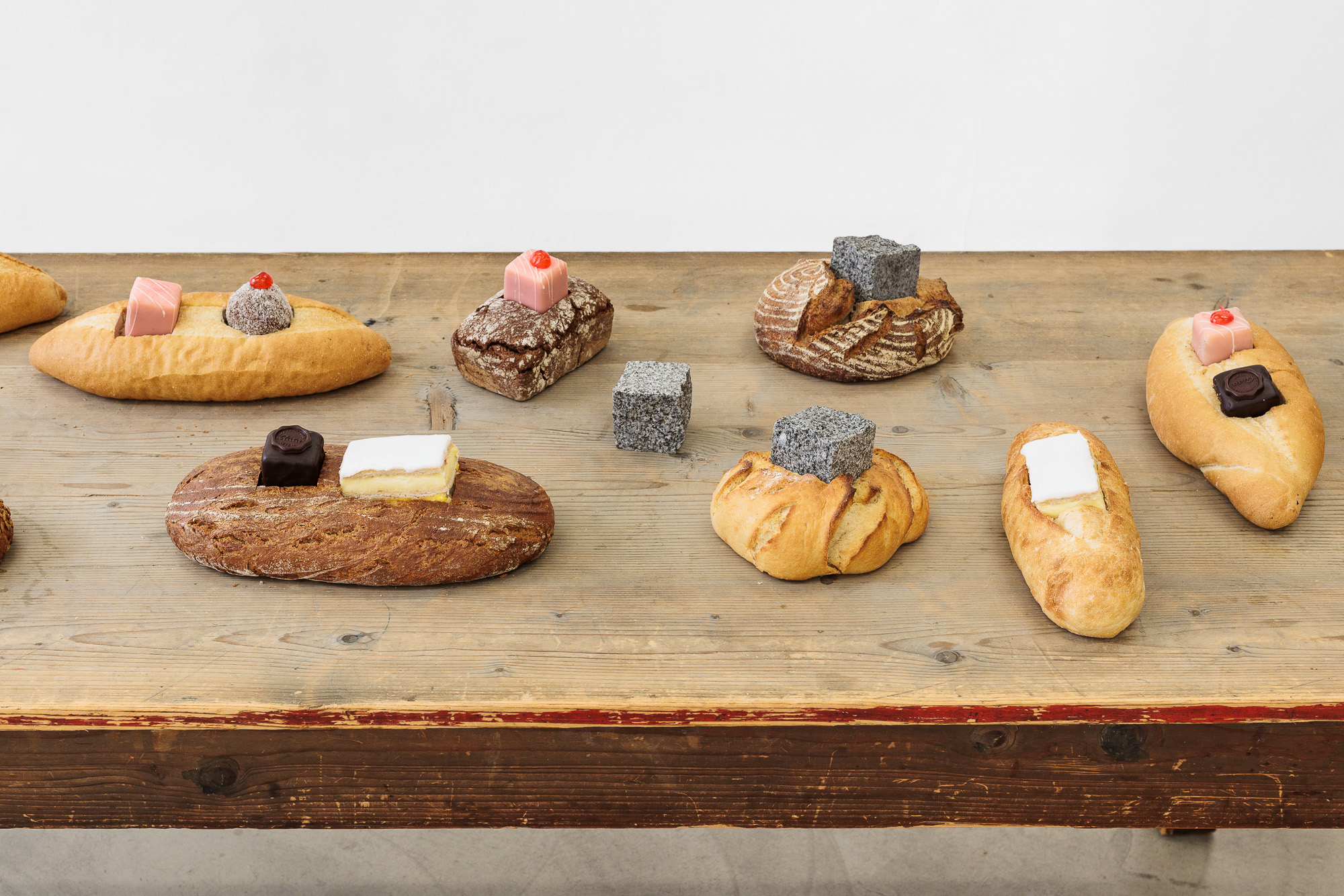
Mladen Stilinovic, Za Mariju Antoinettu '68 / For Marie Antoinette '68, 2008
Installation with loaves of bread containing cakes and stone blocks from block paving on a table, overall dimensions vary with the installation