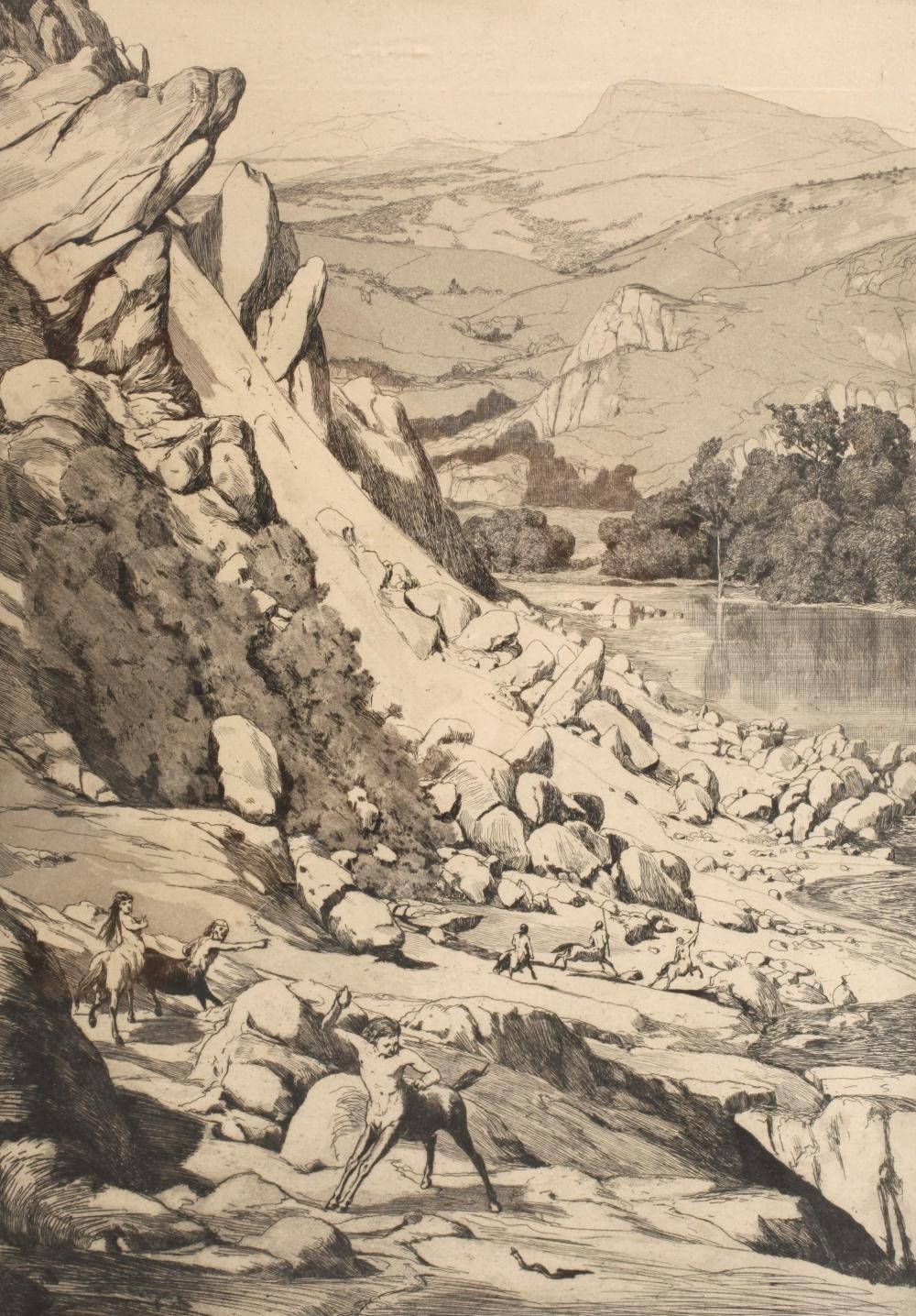
Max Klinger, Sheet 6 from “Intermezzi", Opus IV (detail), first published in 1881
etching on Japanese paper mounted on handmade paper, approx. 39.5 × 27.5 cm
Galerie Martin Janda is pleased to present the group exhibition The Stones of Debris, curated by Thomas D. Trummer, from 2nd December 2026 until 16th January 2027.
Between 1851 and 1853, John Ruskin (1819–1900) wrote ‘The Stones of Venice’, a history of art that viewed architecture not as a succession of styles, but as a moral document. For Ruskin, stone was not a neutral building material. It bore the traces of human labor, of time, effort, and responsibility. In Venice’s Gothic architecture, he recognised individual craftsmanship as a sign of freedom. The industrial mass production of his time, on the other hand, struck him as a loss of dignity, creativity and moral integrity. For Ruskin, architecture became legible as an expression of social values, inscribed in the material itself.
The concept of the ‘speaking stone’ takes on a new layer of meaning in the 20th and 21st centuries. With the Anthropocene, its integration into broader natural-historical contexts comes to the fore. The stone now appears less as a shaped building element and more as a witness, a remnant, or a legacy—as a material in which exploitation, economics and history can be discerned. The Stones of Debris takes up this idea of the sedimentation of history but shifts the focus. It is not the artistically crafted stone that draws attention, as it did with Ruskin, but rather the stone as spoil, fragment, heap, or waste. It appears as material evidence of acceleration, but also of entropy, exploitation, and global inequality—and at the same time as a peculiar manifestation of nature that outlasts human intervention.
In this context, the exhibition interprets stone not as a silent material, but as a condensed archive. As a remnant or deposit, it bears traces of labor, violence, economic systems and ecological interventions. Within it, different temporalities—human history and geological duration—overlap. Stone thus becomes a medium through which social conditions can be read, as well as the ruptures within them.
Text: Thomas D. Trummer